
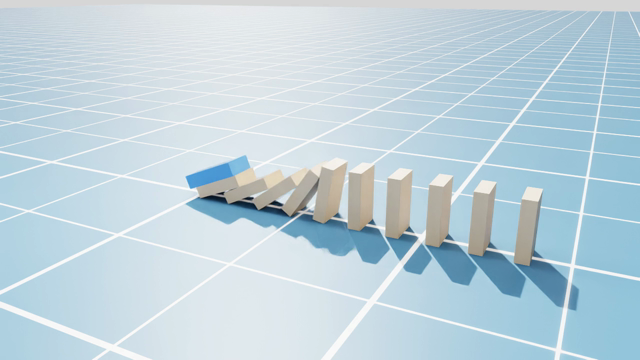
DUNNAGE — ten parcels the simulator toppled and the renderer had to obey
5 of 5 checks passedcapability proof3 red runs on the record
Receipt-derived 3D inspection
Rigid-body parcel run
Compare the caught state with the accepted delivery. The model is an inspection aid; the gallery and receipt remain the evidence.
The receipt
no settled price5 of 5 checks passed
10/10 toppled in order · 0.0 mm rest creep · 360 RTX frames
How the money moved
- saidThe physics must be sim-computed and the picture forbidden to invent any of it — the composition law, sealed before a frame existed.—
- checkedThree red runs are on the record: a shove friction ate, a slide-not-topple that named the tipping law, and a solver creep cured in the solver — never by loosening the bar.—
- passedTen of ten toppled in strict order to true rest, the rendered run's trajectory matched the physics-only run's exactly, and the master passed the full deterministic media battery.—
The catch
3.5 m/s cube — parcel slid 0.30 m, rocked 7.4°, stood back up
7.4°
Then: ten of ten toppled strictly in order (steps 10→169); final-second drift 0.0 mm; parcels rest at exactly half-thickness
The exact record
The machine's own identifiers, kept so anyone can re-check this page against the recorded run. Nothing above is missing from here.
a strike centred at 0.10 m on a 0.45 m parcel shoves the base; the tip condition is contact height > t/(2μ) = 0.10 m
A job like yours
Your job prices on your own words — a fixed quote before any account, money held until the checks pass.
Price a job like thisThe machine — every check, run and refusal, on the recordopen ▾close ▴
The commission
The piece
A short product render whose physics is computed: parcels that topple because they were struck, rest because friction and gravity say so, and a picture that is forbidden to invent any of it. The renderer is the simulator's own ray tracer reading the same scene the solver steps — one process, one lineage, nothing generative anywhere.
Two banked refusals, one cure
Where drawing was impossible
The rented notebook GPU computes physics perfectly and can never draw a frame: its kernel ships no graphics module, so no render device can exist — a refusal probed fresh on a live session and banked, not worked around. The same engine on a plain cloud VM still refused with the identical error — traced to a missing system library the driver quietly requires, installed, cured. The first ray-traced frame followed ten minutes of one-time shader compilation.
notebook $ modprobe nvidia_drm
FATAL: Module nvidia_drm not found — /dev/dri ABSENT

render-vm $ modprobe nvidia_drm → ok · /dev/dri: card0 renderD128
vulkaninfo → deviceName = NVIDIA L4

first frame: 1280x720 · mean brightness 207.01 · sha256 c56bbeae0150…
Red first — the probes earned their keep
The red runs
Three failed attempts are part of the record. A shove that friction ate before it arrived. A harder shove that made the first parcel slide and stand back up — hitting a tall box low shoves its base; the tipping law wants the strike up high. And a finished cascade whose leaning starter crept a millimetre a second forever, cured in the solver's settings rather than by loosening the rest bar.
attempt-12.2 m/s cube pusher — nothing moved
friction ate the shove over its 0.40 m run-up; stop distance 0.49 m
attempt-23.5 m/s cube — parcel slid 0.30 m, rocked 7.4°, stood back up
a strike centred at 0.10 m on a 0.45 m parcel shoves the base; the tip condition is contact height > t/(2μ) = 0.10 m
attempt-3cascade complete, but the leaning slab crept 1.41 mm/s forever
TGS friction drift at default iterations — cured with per-body solver iterations 16/4, not a looser rest bar
Ten of ten, in order, to rest
The clean run
The starter slab slides, pitches forward, and strikes the first parcel near the top. All ten topple in strictly increasing order and the pile reaches true rest — zero drift in the final second, every parcel exactly half its thickness off the floor, and the run's mechanical energy only ever falls.
- parcels toppled, in order
- 10/10
- gravity recovered from the run
- 9.81 m/s²
- drift in the final second
- 0 mm
- ray-traced frames at 30 fps
- 360
Twelve seconds, silent by design
The master
The master is 360 ray-traced frames at thirty a second. The same probe family ran on the rendered run's own trajectory and passed identically — the wave in the picture is the wave in the data.
The bytes, and what the checks made of them
The evidence
Both trajectories, every probe report, the master and its hashes are banked to durable storage before any receipt was written, and the exhibit's numbers are re-read from those files by a test that fails on drift.
the physics must be computed by a real simulator, never generated
every frame depicts PhysX GPU states from the same process; g = 9.81 and 60.0 Hz recovered from the run's own free fall
the parcels must topple in causal order and come to rest
ten of ten toppled strictly in order (steps 10→169); final-second drift 0.0 mm; parcels rest at exactly half-thickness
no energy from nowhere
mechanical energy never exceeded its initial 40.24 J and dissipated to 16.38 J at rest
a 10-20 second master, silent by design, no black frames, no stuck picture
12.000 s / 1280x720 / 30 fps / 360 frames; video_only battery all rows pass; temporal flaws none
frames and trajectory must share one lineage
the render run recorded its own trajectory; its topple steps are identical to the physics-only run's
master sha256 35fd482960132a7e85926087cec18151ffe34e4ad1f2a62b6b2bd40b49cef072 · topple steps [10, 22, 38, 55, 74, 93, 112, 131, 151, 169] · gs://investment-copilot-ocean-experiments-prod/isaac-physics-render-20260806/run-074244/ (12 objects)
The boundary
What this does not cover
No generative model touched a pixel: this piece is the simulator drawing itself. Where a generative renderer might one day re-skin computed states, it enters as a depictor under these same probes — never as the physicist. And the notebook refusal stands: physics there, pixels here.
docs/qa/artifacts/20260806-isaac-physics-render/